
Separating AI Myth from Reality in PACE: Takeaways from NPA 2026
AI is already changing how PACE teams document, coordinate and manage care. But for many PACE leaders, the conversation still carries more anxiety than clarity.
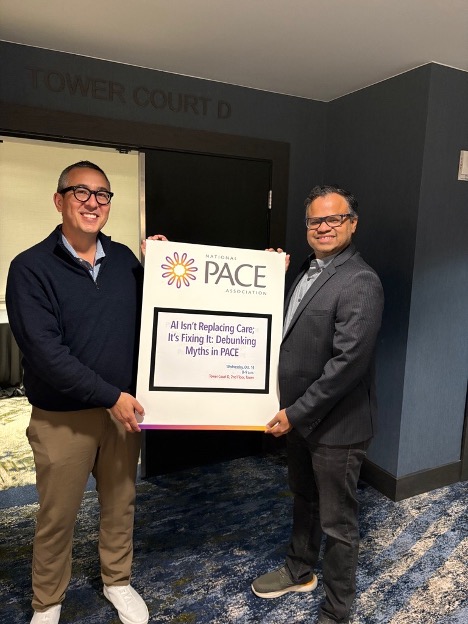
At the National PACE Association Annual Conference in Denver, our session “AI Isn’t Replacing Care — It’s Fixing It: Debunking Myths in PACE” set out to separate the two, in front of a packed room. Ameya Ambardekar, SVP and Head of Engineering at Collabrios Health, was joined by Mark Hull, CEO and Co-founder of Exceeds AI, and Qiana Harrison, CEO of Senior Care Partners PACE, who joined by video. (Disclosure: Exceeds AI is a technology vendor to Collabrios Health.)
The session opened by asking attendees where their organizations stand today: curious and watching, piloting a bounded use case, scaling AI across workflows, or cautious because of risk and uncertainty. The goal was for everyone to leave with one responsible next step.
The model is integrated. The work often isn’t.
PACE brings the IDT, clinical care, services, finance and compliance together under one model. In practice, the work behind them often lives in separate places, and small workflow gaps can create outsized downstream impact. AI adds value only when it can see that full context and return its insight to the right workflow.
Four myths, and the reality
Myth 1: “AI will replace care teams.”
Reality: judgment remains human. AI reduces the distance between a signal and the action it calls for. The panel broke the roles down simply:
- People own the relationship, judgment, consent and accountability.
- AI supports with summarization, pattern detection, drafting and prioritization.
- The workflow delivers the insight where the team already makes decisions and acts.
The design principle: AI proposes. People decide. The system records what happened.
Myth 2: “Any AI tool can solve a PACE workflow.”
Reality: context, boundaries and integration determine usefulness. A generic tool knows language. A useful PACE assistant needs four layers:
- Trusted data about the participant, role, policy and workflow
- Role-aware access so people see only what their role requires
- Domain instructions that define what the tool may and may not do
- Workflow feedback that returns its output to the point of work
As Ameya put it, in PACE, context isn’t a convenience. It’s part of safety and relevance.
Myth 3: “Compliance means we can’t use AI.”
Reality: governance is the design, not the brake. The panel walked through a five-step governance model:
- Use case: Define the purpose, the user, the decision and any prohibited actions.
- Data: Use the minimum necessary data, in an approved environment, with clear retention rules.
- Control: Set access, human review, logging and escalation.
- Validate: Test accuracy, workflow fit and risk, and keep monitoring.
- Evidence: Document decisions, changes and outcomes.
The compliance question every program should be able to answer: “Can we explain who used it, what it produced, and how the final decision was made?”
Myth 4: “We need a big-bang AI transformation.”
Reality: bounded workflows create the fastest path to trust and measurable value. Mark Hull, drawing on what he’s seen across other regulated industries, described a four-step path:
- Start small: one role, one workflow, one outcome.
- Prove value: set a baseline, measure and compare.
- Build trust: review errors and edge cases with users.
- Expand: add adjacent workflows only after the evidence is in.
His advice: pilot the workflow, not the technology. Small doesn’t mean informal, though. A pilot still needs controls, success criteria and an owner.
Where AI delivers value in PACE today
The panel grouped today’s strongest opportunities into three families:
- Care team capacity: Drafting notes and summaries, preparing chart context, surfacing missing follow-up and reducing repetitive documentation.
- Operational visibility: Prioritizing work queues, detecting anomalies and exceptions, summarizing cross-service activity and routing issues to accountable owners.
- Compliance support: Comparing policy to requirements, assembling evidence, identifying gaps for review and maintaining traceability.
Mark was candid that not every workflow needs generative AI. Sometimes rules, analytics or better integration are the better answer. The strongest candidates reduce friction without removing human accountability.
Case study: Senior Care Partners PACE
Qiana Harrison shared how Senior Care Partners PACE took on a question every program faces: why do high utilizers stay high utilizers?
After emergency room use rose 3% in fiscal year 2026, the team identified 18 participants across two centers who accounted for a disproportionate share of hospitalizations. As they framed it, the question wasn’t whether they knew who these participants were. It was why their current process wasn’t changing those participants’ trajectory.
The gaps were operational, not clinical
When they looked closely, the patterns were clear:
- Polypharmacy across nearly all 18 participants
- Key disciplines unstaffed on Thursdays and Fridays
- Most calls needing more than one touch to resolve, with call volume peaking at 10 a.m. and 5 p.m.
- 56% of ER use happening during business hours
- No high-touch care order on file for any of the 18
- A high burden of social needs, including housing, transportation and isolation
What they changed
Using a Plan-Do-Study-Act (PDSA) cycle, the team returned to PACE fundamentals. They held dedicated care-planning huddles, started from each participant’s actual goals, deprescribed psychotropics where possible, right-sized service intensity and placed a high-touch order for every participant. They used complex-case review to challenge groupthink, added a high-utilizer RN to own first-touch calls and tracked progress in the EMR against defined metrics.
The results
Eight weeks in, every tracked metric moved:
- ED visits down 81%
- Zero readmissions
- Cancelled appointments down 48%
- First-touch or proactive RN calls up 27%
- Unmet needs down 71%, and needs not met on time down 52%
- 100% of care-plan actions completed when accepted by the participant
Where AI fits
The fixes were operational, and AI helped make them stick. Senior Care Partners automated data pathways in its EMR intelligence and used AI-drafted IDT notes and task lists to give the team time back. Next, they plan to use AI to cross-reference triage and IDT notes.
It’s the session’s message in one example: AI works best when it strengthens the fundamentals a care team already knows matter.
Increase the intelligence-to-action ratio
Ameya closed with a practical effectiveness model he calls Enterprise Loop Engineering: design the feedback loop, not just the model. The loop runs from friction (where time, quality or visibility breaks) to context (data, role, policy and history), intelligence (a relevant, explainable signal), action (an owner, a decision and a workflow) and learning (an outcome that improves the next cycle).
The measure that matters is the intelligence-to-action ratio: how much useful intelligence becomes appropriate, timely action. More insight isn’t progress if no one can act on it.
Six tips for using AI safely
Our one-page guide pairs the session’s four myths with six practical tips for using AI safely with participant data, from keeping PHI out of public tools to reviewing every output before it reaches the record.
Find your next responsible step
Thank you to Qiana Harrison and the Senior Care Partners PACE team for sharing their work so openly, to Mark Hull, and to everyone who joined the conversation in Denver.
Download the one-page guide to share with your team. Then schedule an AI readiness conversation with Ameya Ambardekar to talk through where your program stands and identify one workflow to start with.